Customize feed attributes
Every feed starts from smart defaults. The attribute editor lets you override any field the channel supports, organized into tabs. Each attribute takes one value for the whole feed, or a set of rules that send different values to different products.
On the attribute tabs, each field shows the Google attribute name it fills, so a warning in Merchant Center points straight at the control that fixes it. Where a field has a deeper guide, hovering that name offers it, and every field has a reference page under Google Shopping attributes.
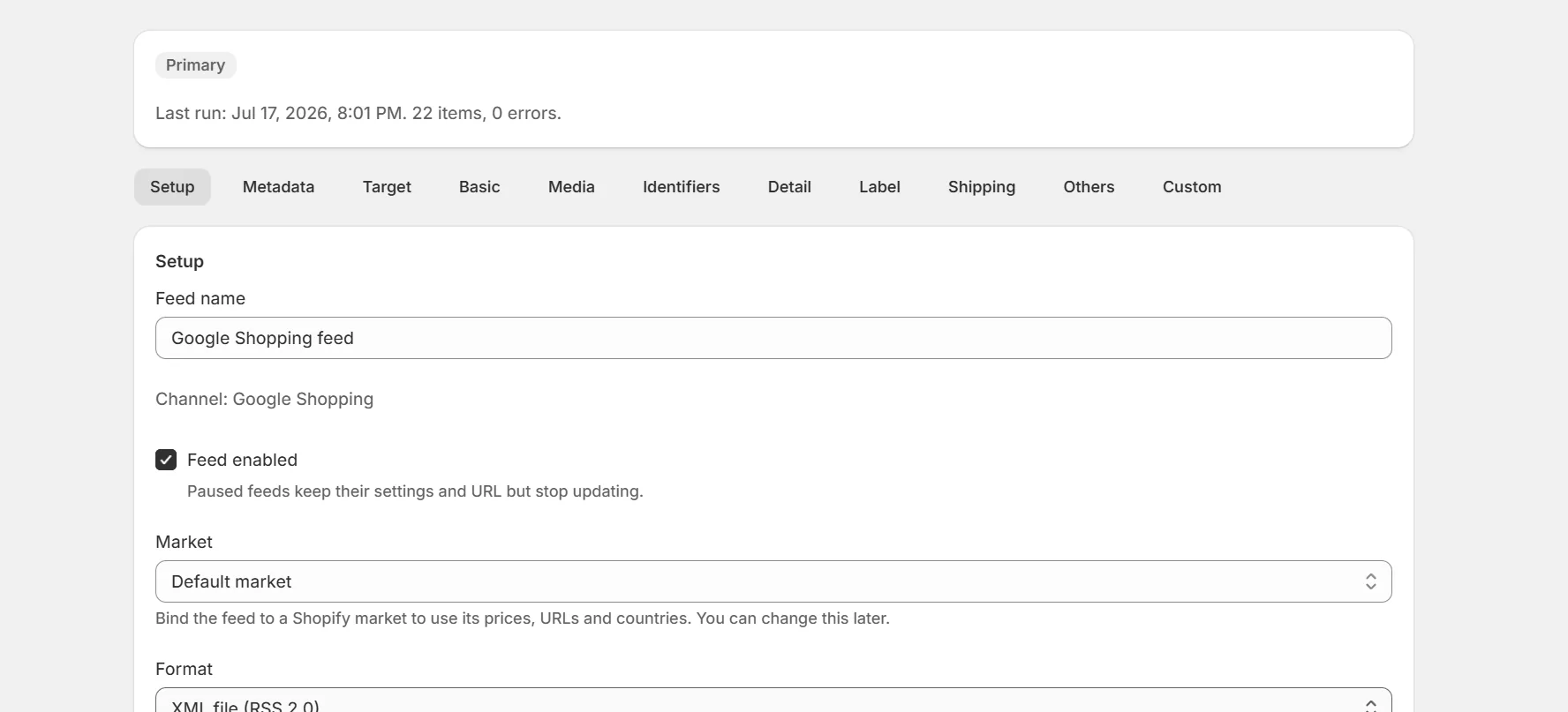
The editor tabs
- Setup: name, enabled state, market binding, file format and compression.
- Metadata: expiration, out of stock handling, variant mode and an optional feed password.
- Target: language, currency, target countries, Google destinations, excluded ad countries and the pause field.
- Basic: item id format, title, short title and description values.
- Media: image order, extra images, lifestyle images, videos, 3D models and document links.
- Identifiers: GTIN, MPN, brand, product category and product type.
- Detail: condition, age group, gender, color, size, material, pattern, size type, multipack, bundle, unit pricing, product dimensions and weight, highlights, product details, energy classes and certifications.
- Pricing: sale price dates, availability date, cost of goods sold, installment plans, subscriptions and loyalty pricing.
- Label: custom labels 0 to 4 for campaign segmentation, and promotion id.
- Shipping: weight, shipping price, package dimensions, free shipping thresholds, handling and transit times.
- AI shopping: questions and answers, related products, variant options, item group title and popularity rank for Google's AI surfaces.
- Others and Custom: product links, mobile and checkout links, and your own extra attributes.
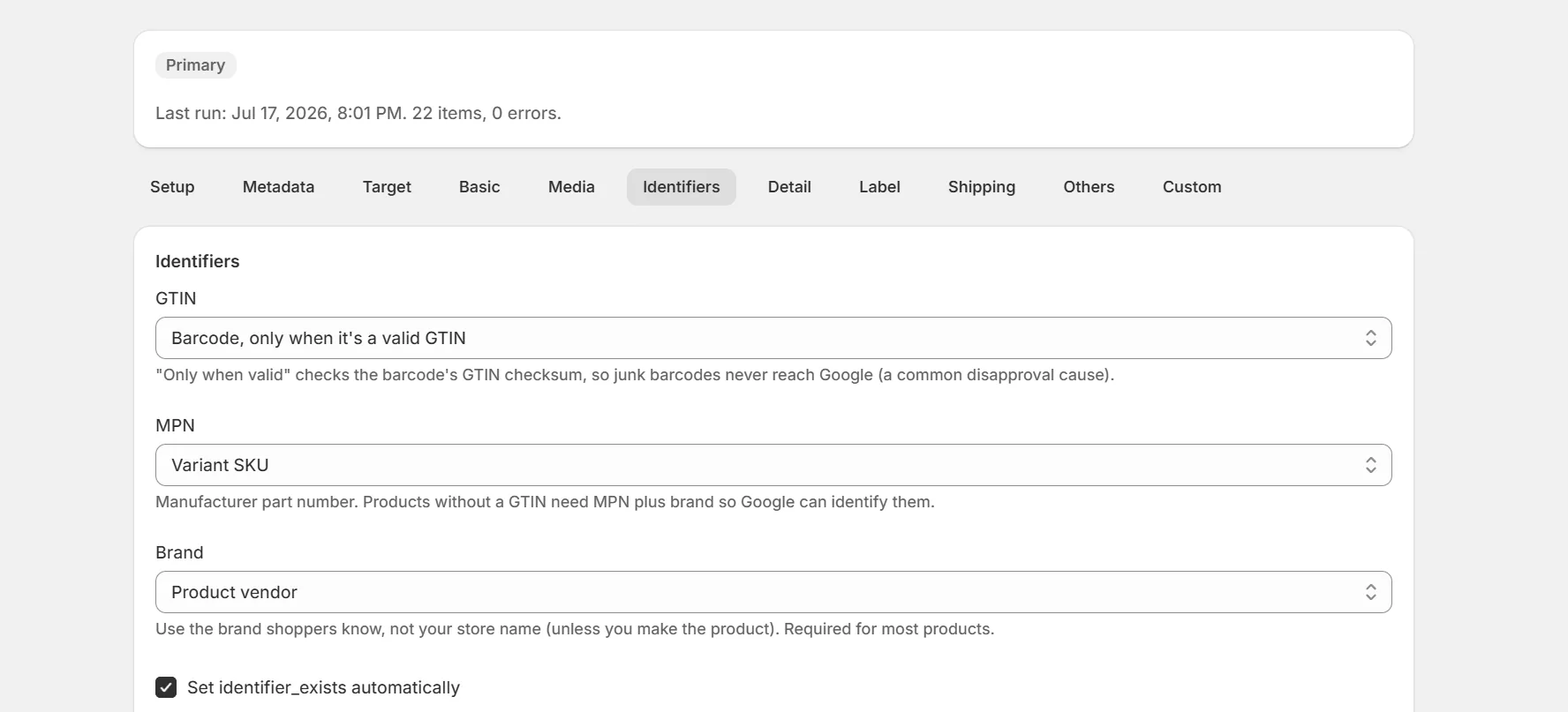
Pick where a value comes from
Every attribute has a value selector. The first choice is always the smart default. The other choices work on any attribute.
- Use a product field: send any product, variant or store field, including any variant option by name.
- Set a fixed value: one value for every product in the feed.
- Combine fields: join several fields with a separator, skipping empty ones.
- Replace values with a table: match a field's values against rows you define and send the replacement. Handy for turning internal names into values Google expects.
- Take part of a field: split a field on a character and send one part, like the middle of a structured SKU.
- Custom expression: full Liquid style expressions for anything else.
- Do not send: leave the attribute out entirely.
Rules for different products
Press Add rule to vary an attribute by product. Each rule starts with Only if conditions on any field, like product type is Shirts or price is greater than 50. A rule with several conditions needs all of them to match. Rules run top to bottom and the first match wins. The pinned All other products rule catches everything else.
Custom expressions
Expression values accept Liquid style expressions with your product data. For example a title expression can combine brand, title and color into one line.
{{ product.vendor }} {{ product.title }} in {{ variant.option.Color }}The preview at the bottom of the editor shows the exact items the channel will fetch, including your customizations.
Feed rules apply to every product they match. For a one-off fix, every mapping tab links to Use overrides, which sets attributes on individual products instead.
Share a rule across feeds
A rule you want in every feed belongs in a master field. Name it after the attribute and every feed that has not set its own rule uses it. Give it any other name and it appears in the field picker of every feed as a value you can build on.
Related articles
Was this page helpful?
Still stuck?
Reach us on the support page or use the support form in the app under Settings. Support hours are 9am to 5pm Monday to Friday, Adelaide time.