Master fields
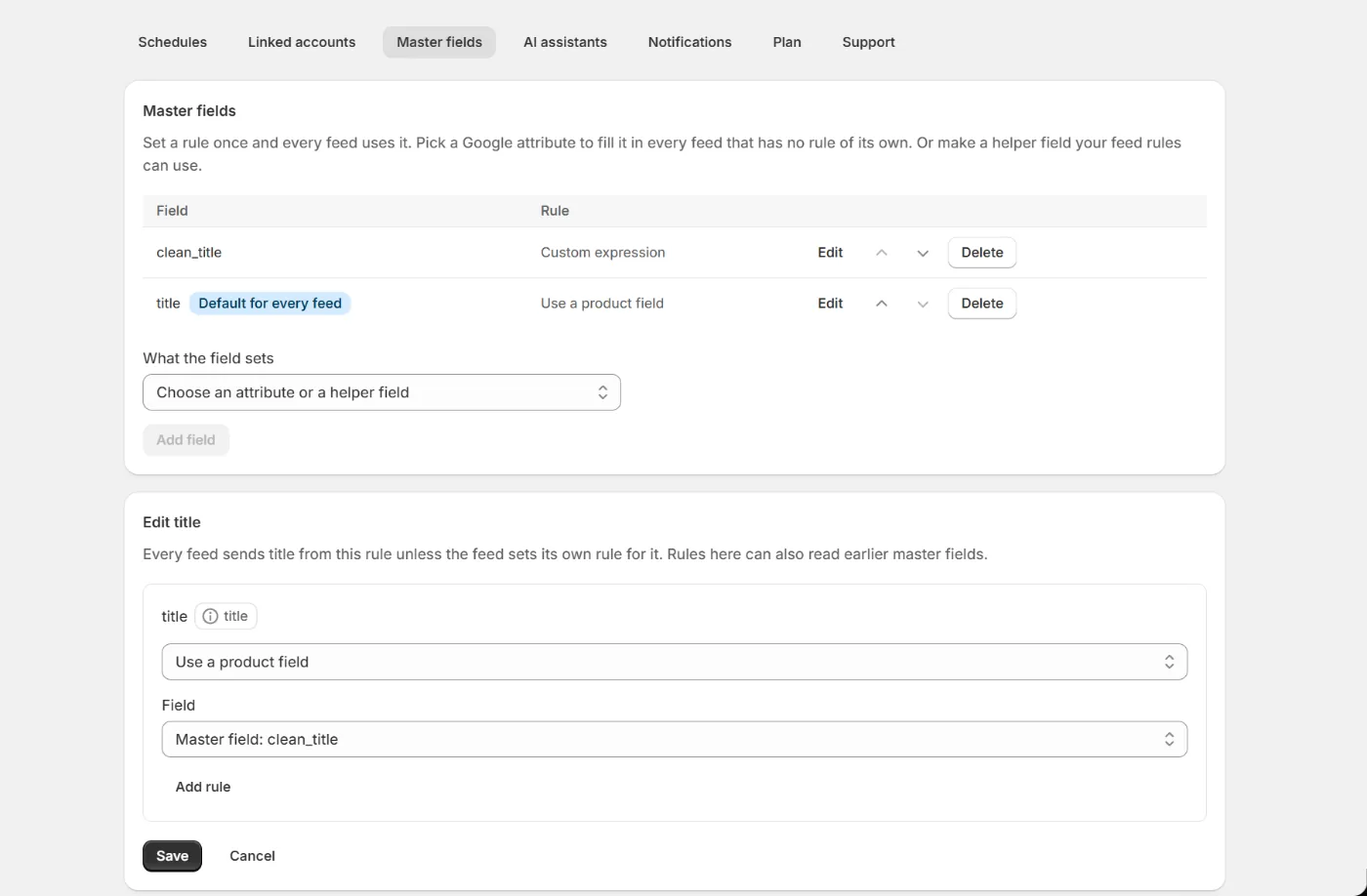
Feed rules live inside one feed. A store with a primary feed, a supplemental feed and a feed per market repeats the same title rule three times and edits it three times. Master fields hold a rule once, at the store, under Settings in the Master fields tab.
Two kinds of master field
- Default for every feed: a field named after a Google attribute, such as title or brand. Every feed sends that attribute from this rule unless the feed sets its own rule for it.
- A helper field with any other name, such as clean_title. Feeds read it as master.clean_title in any attribute rule or custom expression. It is never sent on its own.
Both kinds take the same rule editor as a feed attribute. Conditions, fixed values, combined fields, replacement tables, parts of a field and custom expressions all work. A field can read master fields listed above it, so a helper can feed a default.
Create one
Open **Settings** and pick the **Master fields** tab.
Choose the Google attribute the field sets, or pick A helper field with its own name and type a name. Then press Add field. Helper names use lowercase letters, numbers and underscores.
Build the rule.
The editor is the one from the feed attribute tabs. Save when the rule is right.
Every feed rebuilds.
Feeds that inherit the field pick it up on the next run. Use the up and down arrows on a row to reorder the fields when one needs to read another.
How a feed uses it
In the feed editor, an attribute taking a master field shows Store default (master field) as its value with a link to manage master fields. Pick any other option to give the feed its own rule, and that rule wins in that feed only. Choosing the smart default stores that choice too, so the feed keeps Google's normal value instead of the master field. A feed that already has its own rule can hand the attribute back by picking the master field option.
Helper fields appear in the field picker under their master name. A title rule can combine master.clean_title with the color, and a description expression can print it with the usual double braces.
{{ master.clean_title }} by {{ product.vendor }}. {{ product.description }}A master field cannot be deleted while a feed rule or another master field reads it by name. The refusal names what still reads it, so you can move those rules first. Feeds that simply take their default from the field are not a reference. Delete it and they go back to the built-in default.
Master fields need a paid plan. If you move to the free plan the fields you already made stay saved, and every feed builds from its defaults until you upgrade again. Restoring an older version of a feed restores that feed's own rules and leaves master fields as they are.
Frequently asked questions
Does a master field overwrite a rule I already set in a feed?
No. A feed's own rule always wins. The master field applies only where the feed has left the attribute on its default.
Can I rename a master field?
Not yet. Create a field with the new name, move the rule across, update any feed rules that read the old name, then delete the old field.
Can my AI assistant see master fields?
Yes. The mapping schema it reads lists every master field, and a feed's rules show which attributes take the store default. Creating and editing them happens in the app for now.
Related articles
Was this page helpful?
Still stuck?
Reach us on the support page or use the support form in the app under Settings. Support hours are 9am to 5pm Monday to Friday, Adelaide time.